Beyond Corona: |
Cheladas, micheladas, ojo rojos and the Yucatán-style michelada: what's in them, what they taste like, and which Mexican beer to try with each. |
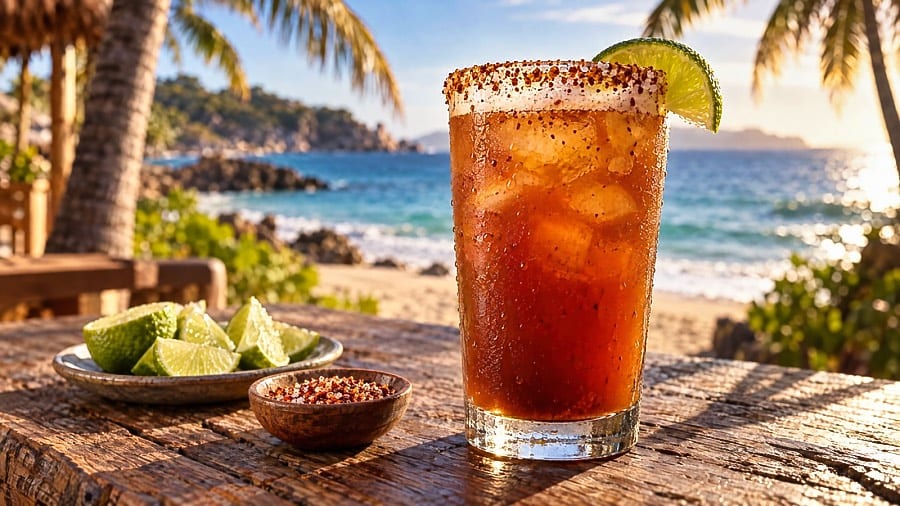
You have seen them at the next table. Tall, frosty mugs with a rim of salt and chile, a lime wedge hooked over the edge, and a drink that is somewhere between amber and blood red. Maybe there is a straw.
Maybe there is a shrimp on top. More often than not, the people drinking them are Mexican families on a Sunday afternoon, workers unwinding after a hot day, friends splitting a plate of seafood.
Those are beer drinks, and they are one of the most Mexican things you can order. Yet many visitors to Puerto Morelos never get past Corona with a lime. That is a shame, because the real thing is more interesting, more refreshing, and much more tied to the place you are visiting.
This is a guide to the family of drinks that Mexicans call cerveza preparada—prepared beer. We will keep the history brief, because the drinks are the point. Then we will get into what they are made of, what they taste like, how the Yucatán does them differently, and which beer to ask for when you order.
A Very Short History
Mexico has been brewing beer since the Spanish arrived in the 1500s, but the country's modern beer culture was built in the 19th century. German, Swiss and other European immigrants brought lager brewing to Monterrey, Orizaba, Mazatlán, Guadalajara and Mérida.
Mexican entrepreneurs built breweries around those skills. By the early 1900s, beer was becoming part of everyday life from the Pacific coast to the Yucatán Peninsula.
The habit of "preparing" beer is old, too. One commonly told explanation is practical: the metal caps on old bottles left a ring of rust around the neck. Drinkers wiped the mouth with a wedge of lime, then dropped the wedge into the bottle. From there, it is a short step to a glass, a pinch of salt and a handful of ice.
The michelada itself has a favorite origin story. In the 1960s, at the Club Deportivo Potosino in San Luis Potosí, a member named Michel Ésper supposedly ordered his beer with lime, salt, ice and a little chile.
The other members started asking for "Michel's lemonade," and the name shortened to michelada. Another version says the word is simply a contraction of mi chela helada—"my ice-cold beer." Nobody has a birth certificate for the drink, and Mexicans happily argue about it over a round.
What is clear is that the idea spread. By the 1980s, micheladas were moving from regional bars into the rest of Mexico. Today you can find them in cantinas, seafood restaurants, street stands, family parties and beach clubs. The recipes change from state to state, sometimes from bar to bar.
The Family Tree
The names overlap, and no two Mexicans will define them exactly the same way. Do not worry about getting the vocabulary perfect. Order by ingredients, and you will be fine. Here are the main branches.
Chelada. This is the simplest member of the family: cold beer, fresh lime juice, salt and ice, served in a chilled glass with a salted rim. That is it. If you have had a Corona with a lime wedge, you have had the idea; a chelada just does it properly.
It tastes like very cold beer with a tart, saline edge—clean, fizzy and dangerously easy to drink. It is the best place to start if you are not sure about the savory versions.
Michelada. A michelada is a chelada plus a savory kit. The classic build includes lime juice, salt, Worcestershire sauce, Maggi seasoning, hot sauce and ice, often with a salt-and-chile rim. Some bars add soy sauce, a pinch of chicken bouillon, or a house-made "black sauce" mix.
The result is salty, sour, savory and gently spicy, with the beer still bubbling underneath. It tastes like the beer cousin of a Bloody Mary, but lighter and more refreshing. The first sip can be a surprise if you are expecting a normal beer. By the second sip, it usually makes sense.
Ojo rojo. Add tomato juice—or Clamato, the tomato-and-clam juice Mexicans love—and the drink turns red. An ojo rojo ("red eye") is beer with tomato, lime, ice and usually a salty sauce or two.
It is thicker and rounder than a classic michelada, with a savory, sometimes briny depth. The name comes from the color, and it has a long reputation as a morning-after drink. It is delicious; it is not medicine.
Cubana. In central Mexico, the full tomato version is often called a cubana. It usually includes beer (often a dark one), lime, salt, tomato juice, Worcestershire, Tabasco and Valentina hot sauce, with a salt-and-chile rim.
It is the most meal-like drink in the family: spicy, tangy and robust. Order one with seafood and you will understand why Mexicans drink these with food.
Michelada con Clamato. Clamato is tomato juice with clam broth and spices. In a michelada it adds salt, umami and a subtle ocean flavor. It is not fishy, think of the depth anchovy gives a Caesar dressing.
This is the version you will find most often on the coast, and the one most likely to be poured at beach bars that cater to visitors. If you avoid shellfish, note that Clamato contains clam broth; ask for plain tomato juice instead.
Michelada yucateca. The Yucatán does it differently. Instead of leaning on tomato, the local style leans on citrus and chile: sour orange or lima agria, fresh lime, cilantro, habanero, Worcestershire and salt.
The result is brighter and more aromatic than a classic michelada, with a heat that arrives fast and clean. It tastes like the peninsula smells, citrus, green herbs and a little smoke from the charred chile.
Fruit micheladas and licuachelas. In the Yucatán and Quintana Roo you will also see mango, tamarind, passion fruit and pitahaya (dragon fruit) micheladas. They are sweeter and fruitier, often blended, and sometimes topped with chamoy and candy.
Mexico City's licuachela takes that idea to its logical extreme: a blender full of beer, sauces, fruit and candy, served in a neon cup. It is ridiculous in the best way.
What They Taste Like
The easiest way to understand the family is to think about what the beer is doing.
In a chelada, the beer is still the star. The lime and salt sharpen it and make it more refreshing, but you are drinking beer. In a michelada, the beer becomes a base for a savory, salty, tart, spicy drink. The sauces are not a garnish; they are the point.
In an ojo rojo or a cubana, the tomato takes over and the drink becomes something closer to a cold soup with bubbles. And in a Yucatecan michelada, the citrus and habanero take the lead, with the beer providing body and fizz.
The classic savory versions are not sweet. That is the first thing that surprises visitors. They are salty, sour, savory and sometimes spicy, with a bitter edge from the beer. They are built for hot weather, fried food, seafood and long afternoons.
If you like a Bloody Mary, a Caesar, a salty lager or a good michelada-style tomato juice, you will probably like these. If you only drink sweet cocktails, start with a chelada and work your way up. And because the base is beer, most of these drinks are relatively low in alcohol—but they go down fast, so pace yourself.
Regional Differences
Mexico is big, and the drinks change with the map.
In the north—Sonora, Sinaloa, Baja California, Nuevo León—the style is direct and refreshing. Light lager, plenty of lime, Clamato or tomato, a chile-salt rim and ice.
The ojo rojo is especially associated with Sonora and Sinaloa. On the coast, micheladas often come with shrimp or seafood, and the line between a drink and a snack disappears.
In the Bajío—Guanajuato, Querétaro, San Luis Potosí—the michelada is more intense. The sauce mix is dark and concentrated, sometimes with chicken bouillon, and tomato is optional.
This is the land of the original michelada story, and a common pairing is cecina (dried meat) or jerky. The flavors are strong because the region likes strong flavors.
In Mexico City, the classic michelada is lime, salt, Worcestershire, Maggi, hot sauce and ice, with a salted rim. The cubana adds tomato. The licuachela is the city's modern street-party version, born in the Tepito and Lagunilla markets.
In Mexico City, the michelada is democratic: you will find it at a sidewalk stand, a cantina, a seafood restaurant and a fancy brunch spot.
On the Gulf coast and in Veracruz, seafood is never far away. Micheladas are often "preparada"—the full works—with Clamato, lime, hot sauce and a shrimp or two on top. The drink is wet, salty and made to be eaten with something from the sea.
And then there is the Yucatán, which deserves its own section.
The Yucatán Difference
The Yucatán Peninsula has its own citrus, its own chile and its own beer culture. That makes its micheladas taste different from the ones you get in Mexico City or on the Pacific coast.
Start with the citrus. Naranja agria—bitter orange—is everywhere in Yucatecan cooking. It shows up in cochinita pibil, in marinades, in drinks. Lima agria is the small, bumpy, intensely sour lime that grows in gardens and gives sopa de lima its name.
Both are sharper and more aromatic than the citrus you find in most supermarkets. Modelo's own Yucatán michelada recipe uses orange juice plus lime juice to imitate the bitter orange, and adds a sprig of cilantro. That tells you a lot: this is a citrus drink, not a tomato drink.
The Yucatecan version leans on citrus, cilantro and habanero rather than tomato.
Then there is the habanero. Yucatecan habanero is floral and sharp, with a heat that arrives quickly and leaves cleanly. It is not the slow burn of chile de árbol or the smoke of chipotle. In a michelada, a little habanero salsa or a few drops of hot sauce is enough. The point is aroma and lift, not pain.
The beer list has local roots, too. Montejo is the crisp, golden lager you will see on plenty of tables. It was launched in 1960 to mark the anniversary of Cervecería Yucateca and named after Francisco de Montejo, the Spanish conquistador tied to the founding of Mérida.
León Negra is the dark one: malty, smooth and a little like a lighter Negra Modelo. Carta Clara is the old-school light pilsner. All three are worth trying on their own, but they are especially good in a michelada.
And the setting matters. In Mérida, cantinas serve free botanas—small plates of panuchos, salbutes or poc chuc—with your drinks. The salty food makes you thirsty; the michelada makes you hungry. It is a virtuous circle. In Puerto Morelos, you can recreate the experience at any bar with a good snack menu.
If you want the Yucatecan version in Puerto Morelos, ask for a michelada with lime and orange juice, habanero and cilantro. If the bartender looks at you blankly, ask for a "michelada yucateca" and hope for the best. The best bars will know exactly what you mean.
Which Beer To Try With Which Drink
The beer matters, but not in a snobby way. You want a clean lager that will not fight the lime, salt, tomato or chile. Save the hoppy IPA for another night. As one Zacatecas bartender told National Geographic, artisanal beer has too much taste for a michelada.
Here is a practical guide, starting with the easiest beers and moving toward the darker ones.
Pacifico Clara is a crisp, light pilsner-style lager from Mazatlán, 4.4% alcohol, with a mild, slightly sweet flavor. It is the ideal beer for a chelada or a first michelada because it lets the lime and salt shine. If you are new to these drinks, start here.
Modelo Especial is a fuller pilsner-style lager, also 4.4%, with a soft, bready, orange-blossom aroma and a clean finish. It is the all-rounder: good in a classic michelada, a Clamato version, or a fruit michelada. When in doubt, order Modelo Especial.
Dos Equis Lager Especial is a golden pilsner-style lager, 4.2%, mild and slightly earthy with a clean finish. It is a classic choice for a michelada. It will not overpower the Worcestershire and Maggi, and it keeps the drink light.
Tecate is a crisp, full-bodied lager from Baja California, 4.5%, with a slightly bitter finish. It is the norteño choice, and it is excellent with Clamato and a chile-salt rim. If you like a little more bite in your beer, try Tecate.
Negra Modelo is a dark lager in the Munich dunkel tradition, 5.4%, with caramel, toasted malt and a smooth finish. It is the best beer for an ojo rojo or a cubana because it has enough body to stand up to tomato. It also makes a richer, darker michelada.
León Negra is the dark Yucatecan classic: malty and smooth, lighter than a stout, with a nice roasted edge. Use it in a Yucatecan michelada when you want more backbone than Montejo. It is also good in an ojo rojo.
Montejo is the Yucatecan golden lager: crisp, clean and slightly bready. It is the local default for a chelada or a Yucatecan michelada. If you are in Mérida, order it; if you are in Puerto Morelos, ask for it.
Carta Clara is a light, old-school Yucatecan pilsner. If you see it, try it in a chelada. It is subtle and very drinkable.
If you want to go further, Victoria is a Vienna-style amber lager with a malty, smooth flavor that works well in a michelada. Bohemia is a richer, hoppier Czech-style pilsner; it is better on its own or with lime than in a heavy tomato drink. Indio is a dark Vienna-style lager with caramel and toasted malt, a good alternative to Negra Modelo in an ojo rojo.
If you only try three, make them a Pacifico chelada, a Dos Equis Lager michelada and a Negra Modelo ojo rojo. That is the arc of the whole family in one afternoon: bright and simple, then savory and spicy, then dark and tomato-rich.
How To Order In Puerto Morelos
The vocabulary is simple, and nobody expects you to speak perfect Spanish. A few phrases will take you a long way.
"Una michelada, por favor" gets you a michelada. If you want the full works, say "preparada." If you want just beer, lime and salt, ask for a "chelada." If you want tomato or clam juice, say "con Clamato." If you do not, say "sin Clamato."
If you are watching your salt, ask for "poca sal" or "sin sal." If you want it extra cold, say "bien fría." If you do not want ice, say "sin hielo." And if you want the glass rimmed with salt and chile, ask for it "escarchado."
It also helps to ask what beer they use: "¿Qué cerveza usan?" A good bar will have a house lager, and it will usually be a clean one. If they offer you a choice, pick one of the beers above.
For a first stop, try Micheladas del Semáforo on the La Colonia side of Puerto Morelos, near the highway and the Super Chedraui. It is a casual bar and restaurant that specializes in micheladas, including a standout mango version called Mangochela.
It has live music, a pool table, burgers, tacos and a friendly crowd. It is listed as open daily from noon to midnight, which makes it a good place for a late lunch or an early evening drink. It is also easy to reach from the colectivo stop, so you can stop on your way into town.
Many other bars in Puerto Morelos will make you a michelada even if it is not on the menu. The magic words are "michelada por favor." If they ask "con Clamato?" you can say yes or no.
If you want the Yucatecan style, ask for lime and orange juice, habanero and cilantro. If they do not have habanero, a good hot sauce will do. And if they do not have Montejo or León Negra, ask for Modelo Especial or Pacifico, both make a fine stand-in.
Make One At Home
The ratio matters more than the brand. For one tall 20-ounce glass, start with a cold glass and a rim of salt and chile powder. Rub the rim with a lime wedge first so the salt sticks.
Add ice, then one ounce of fresh lime juice, two dashes of Worcestershire sauce, one teaspoon of Maggi seasoning (or soy sauce), and half a teaspoon of hot sauce. Stir the lime and sauces with the ice until they are combined.
Pour in 12 ounces of cold Mexican lager slowly, down the side of the glass, so it does not foam over. Stir once, gently, and top up with the rest of the beer as you drink.
For an ojo rojo, add three to four ounces of tomato juice or Clamato and cut back on the Maggi. For a Yucatecan version, use one and a half ounces of orange juice and three-quarters of an ounce of lime juice instead of the lime, add a small sprig of cilantro and a teaspoon of habanero salsa, and go easy on the Worcestershire.
A non-alcoholic lager works well, too. The tomato, lime and sauces carry most of the flavor; the beer is there for fizz and body.
A quick glossary
Chela — beer.
Chelada — beer, lime, salt and ice.
Michelada — beer, lime, salt, savory sauces and usually ice.
Ojo rojo — "red eye"; beer with tomato juice or Clamato.
Cubana — the full tomato-and-sauce version, often with dark beer.
Clamato — tomato juice with clam broth and spices.
Escarchado — rimmed with salt, chile or both.
Bien fría — ice cold.
Botana — a small snack served with drinks, especially in cantinas.
Naranja agria — sour orange, a key Yucatecan citrus.
Lima agria — the small, sour Yucatecan lime.
Habanero — the floral, fiery chile of the Yucatán.
One Last Sip
The first sip of a michelada can be a bit of a shock. It is salty, sour, savory and spicy, and only then beer.
Start with a chelada if you are unsure. Move up to a classic michelada. Try an ojo rojo with seafood. And when you are in Mérida or Valladolid, order the Yucatecan version and taste the difference. Your Corona-with-a-lime days may be numbered.
¡Salud!
Tried one? Tell us where you had it, we are always looking for the next great michelada in Puerto Morelos. |
