Worst Sargassum Season on Record Is Finally Retreating From Mexico's Caribbean Coast |
After surpassing 100,000 tons collected and hitting 27 times the historical average, shifting currents and a natural reef barrier are giving Riviera Maya beaches the relief so desperately needed. |
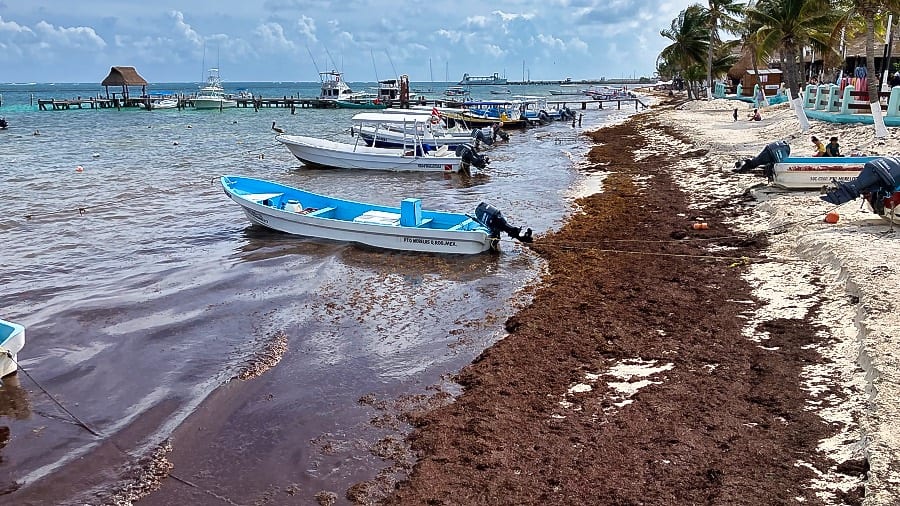
The worst sargassum year on record is finally easing up.
Puerto Morelos got hit hard this summer, but the seaweed is starting to move on.
A Record-Breaking Season
Officials said the 2026 season has already surpassed previous annual records and is tracking well above last year's total.
By early to mid-August, crews across Quintana Roo had collected more than 100,000 tons of sargassum. Esteban Amaro Mauricio, coordinator of the Environmental and Sargassum Monitoring Center, said the annual total could reach about 119,000 tons.
Officials have described 2026 arrivals as roughly 27 times the historical average.
The Good News: It's Heading North
Arrivals along Mexico's Caribbean coast have dropped about 25 percent in recent weeks. As the season advances, currents typically push sargassum farther north across the Caribbean. "That happens every year as summer progresses, thank God," Amaro Mauricio said.
May, June and July are historically the hardest months. From August onward, sargassum begins to decline, with a more noticeable drop expected around the start of autumn on September 22.
How Puerto Morelos Held Up
Puerto Morelos had an advantage this season that most of its neighbors did not. The barrier reef offshore helped intercept and break up many sargassum mats before they reached the beach, part of the Mesoamerican Barrier Reef System, the second largest in the world.
Puerto Morelos also deployed 2.3 kilometers of sargassum containment barriers along the coast. And municipal crews, together with Navy personnel, cleared beaches daily at the height of the season, focusing especially on Ventana al Mar and Playa Sol, both of which hold Blue Flag international certification for 2026-2027.
"We know that sargassum is a natural phenomenon that affects much of the Caribbean coast," the mayor said. "However, in Puerto Morelos we have important allies, such as our 2.3 kilometers of sargassum barrier and the protection provided by our reef."
Where Does Sargassum Come From?
Recent research traces much of the Atlantic sargassum belt to source regions in the tropical Atlantic, with growth then amplified by nutrient inputs and warming seas.
Warmer sea-surface conditions and nutrient pollution have contributed to the explosive growth of sargassum in recent years.
What About Next Year?
Early monitoring off Africa's coast suggests next year's sargassum levels could be similar to this year's, though the forecast remains uncertain. Amaro Mauricio cautioned that atmospheric and oceanographic conditions change constantly, so "nothing is written."
The Mexican Navy continues to deploy vessels and personnel along the coast as part of the cleanup effort. But the plan now is to build up resources for 2027, not spend them chasing a tide that is already turning.
For Puerto Morelos, the reef and the barriers bought the town breathing room during the worst of it. That combination will matter even more if next year is as strong as forecasters suggest. |