The Mexican Navy's Sargassum Cleanup Boats Are Sidelined |
The specialized vessels best suited for nearshore seaweed collection are sitting in a repair yard in Chetumal |
The Navy's Cleanup Boats Are in the Shop. Here's What That Means for Puerto Morelos.
Right now, at what could be the worst sargassum season on record, the Mexican Navy's specialized seaweed collection vessels are sitting in a repair yard in Chetumal, not in the water off our coast.
The Timing Could Not Be Worse
According to the Mexican Navy's XI Naval Zone (headquartered in Chetumal), the specialized seaweed collection vessels are currently undergoing preventive and corrective maintenance at the Chetumal Naval Base facilities, rather than being deployed in the water.
The boats in question are the three shallow-water Aquamarina-type sargassum vessels, the ones best suited for working close to shore where the seaweed does the most damage.
The naval commander said the boats could remain out of operation for up to a month, during which containment efforts at sea will rely on other available resources. That is a long time to be without your best tools when a wave of seaweed is already on its way.
What Is Coming Our Way
This is not a normal sargassum year. The Great Atlantic Sargassum Belt, which spans from West Africa to the Gulf of Mexico, has experienced significant blooms since 2011, with fluctuating intensity in recent years.
While precise tonnage predictions for the 2026 season vary, oceanographic models indicate a substantial volume of macroalgae is moving toward the Caribbean Sea and Florida, posing a continued threat to coastal ecosystems.
Oceanographic models warn that about 3 million tons of the macroalgae are moving toward the Caribbean Sea, including Quintana Roo's shores.
The Mexican Navy and local authorities have been actively collecting sargassum along the coastline of Quintana Roo throughout the 2026 season.
While official cumulative tonnage figures for the year are still being finalized, authorities confirm that additional waves of macroalgae are expected in the coming weeks, necessitating continued vigilance.
Puerto Morelos Has a Natural Advantage, But It Is Not a Shield
Puerto Morelos is in a better position than most towns along the Riviera Maya, and that is not an accident of luck.
Puerto Morelos has a biosphere reef running parallel to shore, roughly 500 meters out, part of the Mesoamerican Barrier Reef System, the second largest in the world, which intercepts and breaks up many sargassum mats before they reach the sand.
In record years like 2025 and 2026, the protection is not complete, but heavy events are shorter in duration and recovery is faster than at open-coast beaches. Still, residents have already noticed the difference this season.
What Is Actually in Place Right Now
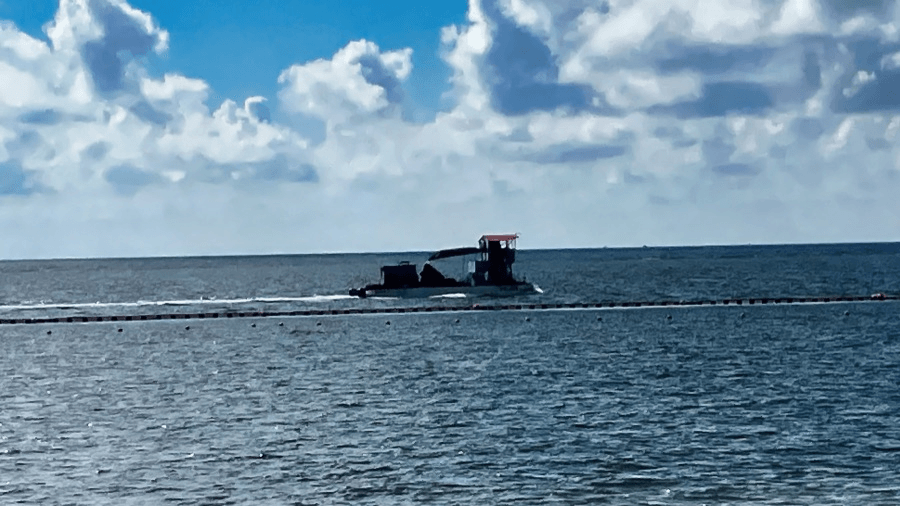
The good news is that Puerto Morelos is not unprotected. The Navy successfully installed over 9,050 meters of anti-sargassum barriers along the coast of Quintana Roo, including 2,400 meters in Puerto Morelos.
Local authorities coordinated that effort with hotels and the municipality ahead of the season.
The operational force dedicated to combating sargassum includes one transoceanic vessel, one coastal sargassum vessel, 22 smaller boats, and three shallow-water Aquamarina-type sargassum vessels.
The larger ocean-going vessel and the smaller support boats remain active, working to intercept sargassum before it reaches the barriers.
What to Watch For
The next few weeks are critical. Officials are working on new strategies to strengthen open-water interception, trying to catch the seaweed before it ever gets close to shore.
The Navy's brigades are still active on the beaches, and the barriers are in place. But with the specialized vessels out of service during peak season, the margin for error is thin. |