Rotting Sargassum Near the Ruta de los Cenotes May Be Contaminating Local Drinking Water |
Scientists are now using the same seaweed to develop filtration membranes that could protect the Yucatan's underground aquifer from the very toxins it produces |
Every year, Puerto Morelos crews remove large amounts of sargassum from the beach and transport it to containment areas inland.
It sounds like a clean solution. But scientists are raising a question that hits close to home: what happens when all that rotting seaweed sits near our cenotes?
The Hidden Problem Under Our Feet
The Yucatan Peninsula has no rivers. Every drop of drinking water here comes from a vast underground aquifer, connected by a web of caves, rivers, and cenotes.
When sargassum decomposes, it produces a toxic liquid called leachate. Research published in Marine Pollution Bulletin found that this leachate contains heavy metals including aluminum, cadmium, arsenic, and lead.
Scientists have warned that leachates from decomposing sargassum may contaminate groundwater when the seaweed is dumped on inadequate land deposits.
Scientists Are Turning Trash Into a Solution
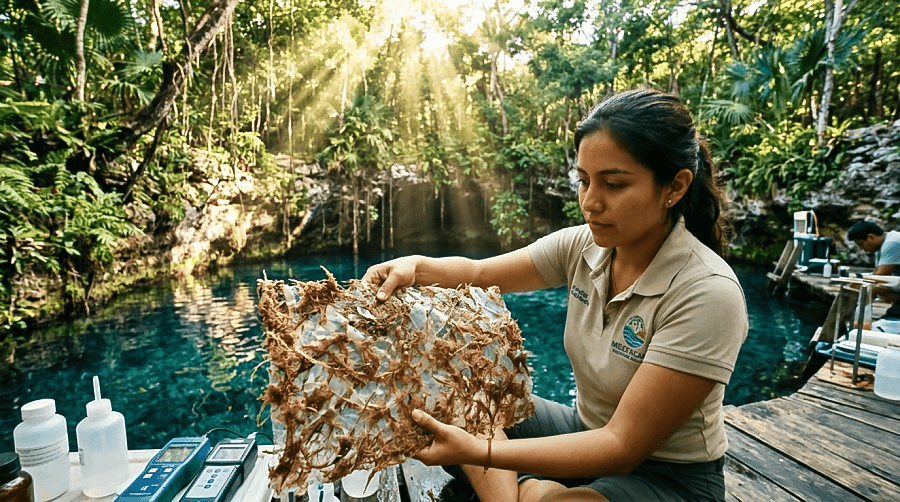
Here is where the news gets interesting. Researchers at the Autonomous University of Yucatan (UADY) in Merida have developed filtration membranes made from two things we have plenty of around here: sargassum and recycled PET plastic bottles.
The project, led by researchers at the Autonomous University of Yucatán, is developing filtration membranes to remove a range of contaminants from water.
These membranes are designed to capture and bind contaminants, including heavy metals, rather than only trapping suspended particles.
Project coordinator Irving Gonzalez says the goal is to remove a wide range of pollutants in a single system. The researchers are developing membrane-based materials intended to remove contaminants such as heavy metals from water.
Why This Matters Right Here
Puerto Morelos removes substantial amounts of sargassum from its beaches each season. That seaweed ends up at the containment site on the Ruta de los Cenotes, where it is dried and sifted before the sand is returned to the beach.
That road is named for a reason. The cenotes along the route are connected to the region's underground aquifer, which supplies much of the local water.
Monitoring of sargassum-related contamination in the region has raised concerns about possible impacts on groundwater.
The membranes are still being developed, and researchers are working toward more advanced filtration systems.
The Bigger Picture
The irony here is hard to miss. The same sargassum that creates disposal problems may also provide raw material for water-cleaning technologies. That is the kind of thinking this region needs.
Puerto Morelos has been ahead of the curve on sargassum management compared to much of the Riviera Maya.
Keeping that edge means paying attention not just to what lands on the beach, but to what happens to it after the trucks drive away. |