That Rotten Egg Smell on the Beach Could Be Harming Your Health |
Scientists Are Now Measuring the Toxic Gases Released by Rotting Sargassum, and the Results Are Raising Serious Concerns for Coastal Communities |
You have probably noticed it. That sharp, unpleasant odor hanging in the air when a big pile of sargassum starts rotting on the sand.
Most people wrinkle their nose and walk away. Scientists are now saying that smell is a warning sign worth taking seriously.
A New Monitoring Station Changes the Game
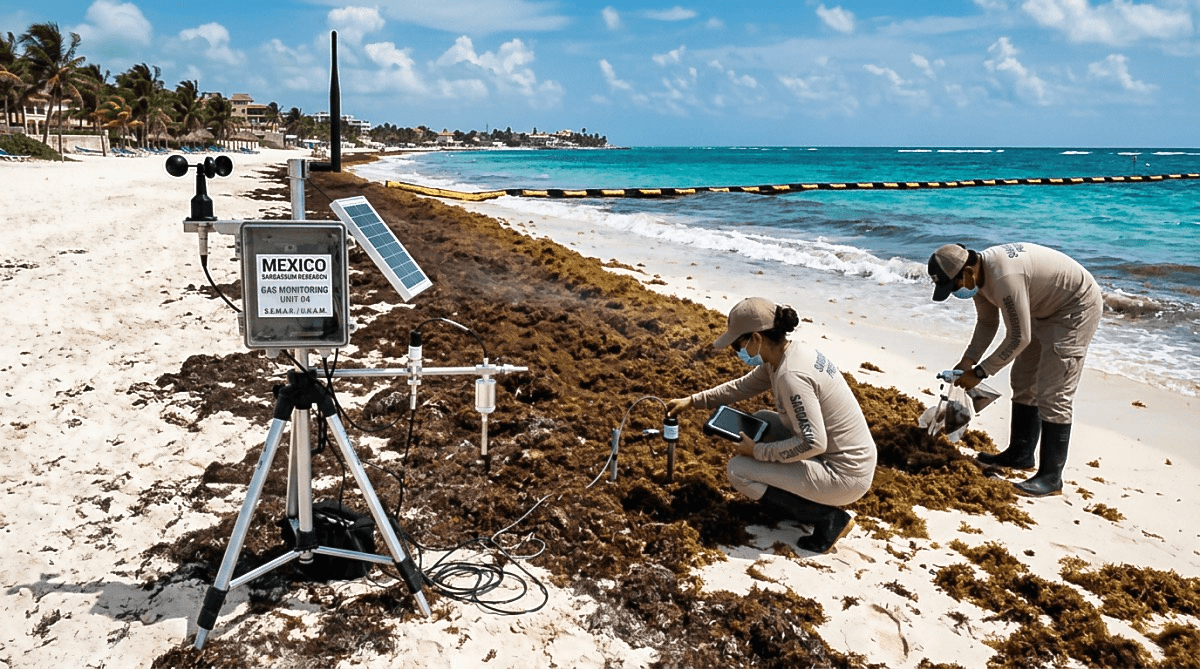
Researchers from the Scientific Research Center of Yucatan (CICY) recently installed a specialized gas monitoring station in Playa del Carmen to track exactly what is being released when sargassum decomposes on the beach.
The station measures carbon dioxide, methane, ammonia, and compounds related to sulfuric acid, including hydrogen sulfide, the gas behind that rotten egg odor.
This station joins a growing international network of monitoring sites across Caribbean countries, all aimed at building faster early warning systems for massive sargassum arrivals.
What the Gases Actually Do to Your Body
Hydrogen sulfide is the gas scientists are most concerned about. According to the U.S. Environmental Protection Agency, prolonged exposure can cause upper airway irritation, nausea, headaches, dizziness, and neurological effects.
Studies have linked sargassum gas exposure to potential respiratory and neurological effects, though comprehensive regional data remains limited.
Research on hydrogen sulfide (H₂S) from sargassum decomposition indicates potential exposure risks for cleanup workers, with levels that may exceed safe thresholds during peak events, though site-specific data requires further validation.
Puerto Morelos Is Right in the Middle of This
Our town is one of three areas identified as most vulnerable to sargassum along the entire Riviera Maya, alongside Playa del Carmen and Tulum.
The municipality is working to protect 20 kilometers of coastline, with offshore barriers deployed to intercept seaweed before it reaches the beach.
Quintana Roo has faced significant sargassum influxes in recent years, with collections requiring substantial efforts to manage coastal impacts. The seaweed arrived earlier than usual, starting in January rather than the typical March window.
Some research has raised concerns about heavy metals like arsenic in sargassum, prompting authorities to explore controlled uses such as biogas production.
Efforts are underway in the region to develop sustainable sargassum uses, such as biogas production, through proposed facilities.
What You Can Do
Avoid spending long periods next to large decomposing sargassum piles, especially when the smell is strong. Move upwind if you can.
People with asthma or respiratory conditions should be especially cautious. |